
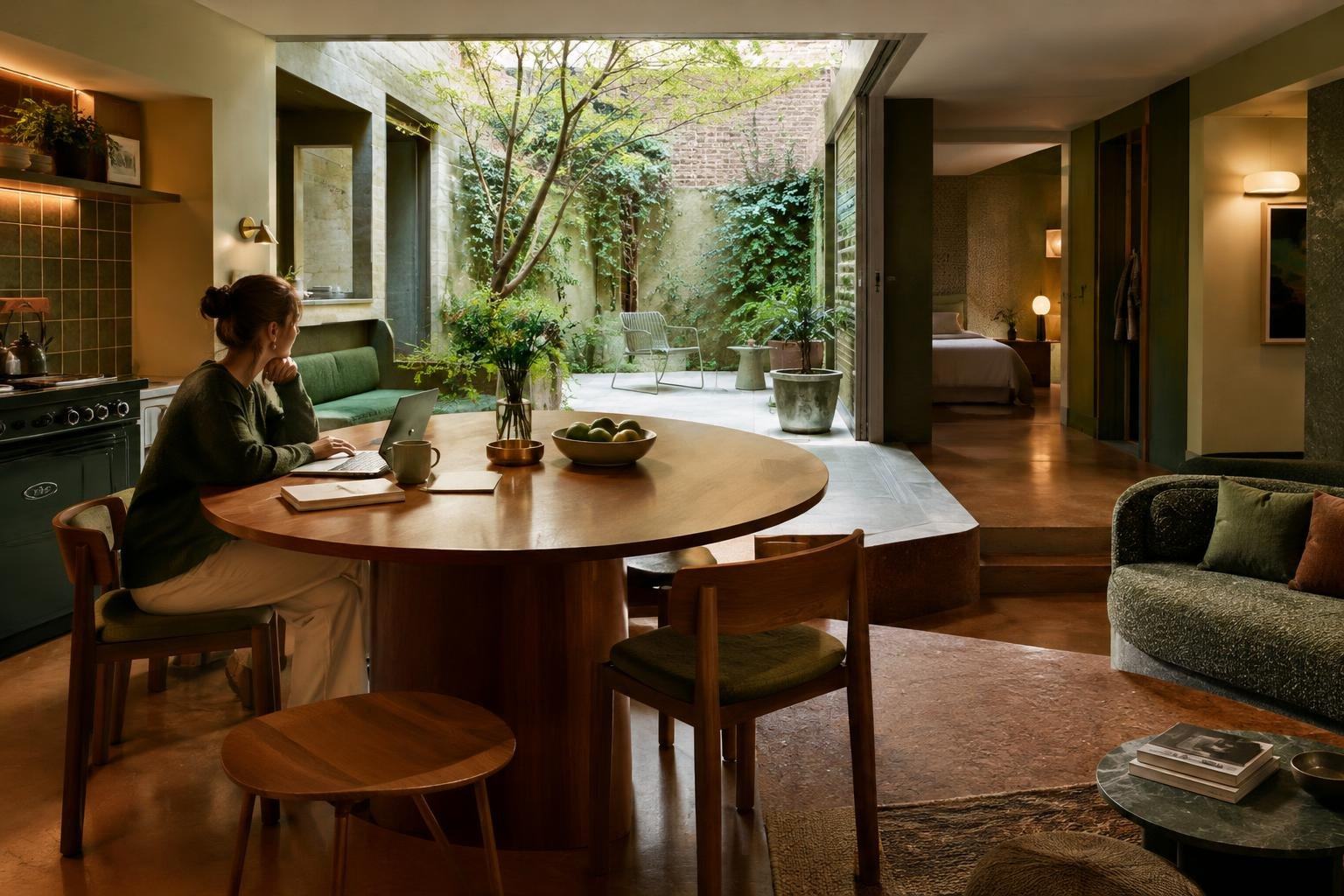
Small homes are often treated as puzzles to solve with more storage and fewer possessions. Studio8, a renovated basement apartment in Melbourne, offers a more intriguing question: can a compact home feel spacious because of the way it moves, not just because of what it contains?
The answer, in this case, involves a courtyard nearly as large as the apartment, a bedroom reached by a winding route, and a round table asked to do several jobs. Renovated at the end of 2024, the home received the Emil Sodersten award for interior architecture at Australia’s National Architecture awards on 29 October 2026.
Make a small home feel like a sequence, not a box
Studio8 occupies a semi-subterranean former laundry at the heritage-listed Quamby apartment complex in Toorak. The building was designed by Australian architect Roy Grounds in 1941; the basement had later been converted into an apartment, in a 1970s project that its owner Ronnen Goren describes as being in grim condition.
Architect Timothy Hill of Partners Hill approached the renovation as a chance to make a small home, rather than a scaled-down version of a large one. That distinction shapes the plan. To reach the bedroom, visitors cross the courtyard, pass the apartment’s entrance and loop back through a tiny hall. The detour gives the sleeping area a sense of separation that a straight, open-plan layout might not.
Hill is sceptical of the idea that removing partitions automatically makes a small home feel bigger. When cooking, eating and relaxing all happen in one uninterrupted space, he argues, the result can feel less like a generous room than a room carrying too many visible functions. Studio8 instead preserves a separate, compact kitchen, with room for an Aga stove and a built-in breakfast nook.
Give every feature more than one reason to be there
The standout example is a large round table near the terrace. It works as an entry surface, a place to work from home, a dining table, a cocktail bar and storage. Its position beside the sunken lounge gives the living area a focal point without requiring a separate piece of furniture for every activity.
That is not simply a clever shopping list. Multipurpose design works best when the jobs suit one another: a table can host lunch and a laptop, but it still needs enough clear surface for either. Studio8’s more unusual details follow the same logic. In the bathroom, one bent-steel fitting serves as a vanity bench, basin support, laundry-basket surround and towel rail, among other functions; four screws hold the piece together.
Storage is also placed where it can protect the feeling of a room. Clothes go in a walk-in space across from the bedroom instead of in built-in wardrobes along its walls. That choice keeps the bedroom visually quieter, while the storage remains close at hand. Thick walls, a green colour scheme and sound-absorbing finishes—including cork in the living area and a carpeted bedroom wall—contribute to the enveloping atmosphere Goren values.
Borrow the principle, not necessarily the floor plan
Not every small home has a generous courtyard, and a renovation that preserves a separate kitchen may not suit every budget or building. Nor does a tiny apartment become comfortable simply by adding a multipurpose table. Studio8’s approach depends on its particular layout, its existing structure and the relationship between indoors and outdoors.
Still, its ideas can prompt useful questions in any home. Which activities genuinely need their own zone? Could a desk share a surface with dining, or would that make both harder to use? Is there a quieter place for bulky storage than the room where you sleep? And would a small change in the route between spaces make daily life feel less crowded?
Hill says improvements in waterproofing have made it easier to convert old, unconventional spaces, and sees reuse as potentially valuable because a building and its infrastructure are already in place. The broader lesson is not that everyone should live in less space. It is that the quality of a home depends on how thoughtfully its space is arranged. In Studio8, even a short walk to the bedroom helps make a basement feel like a home with room for a little journey.