
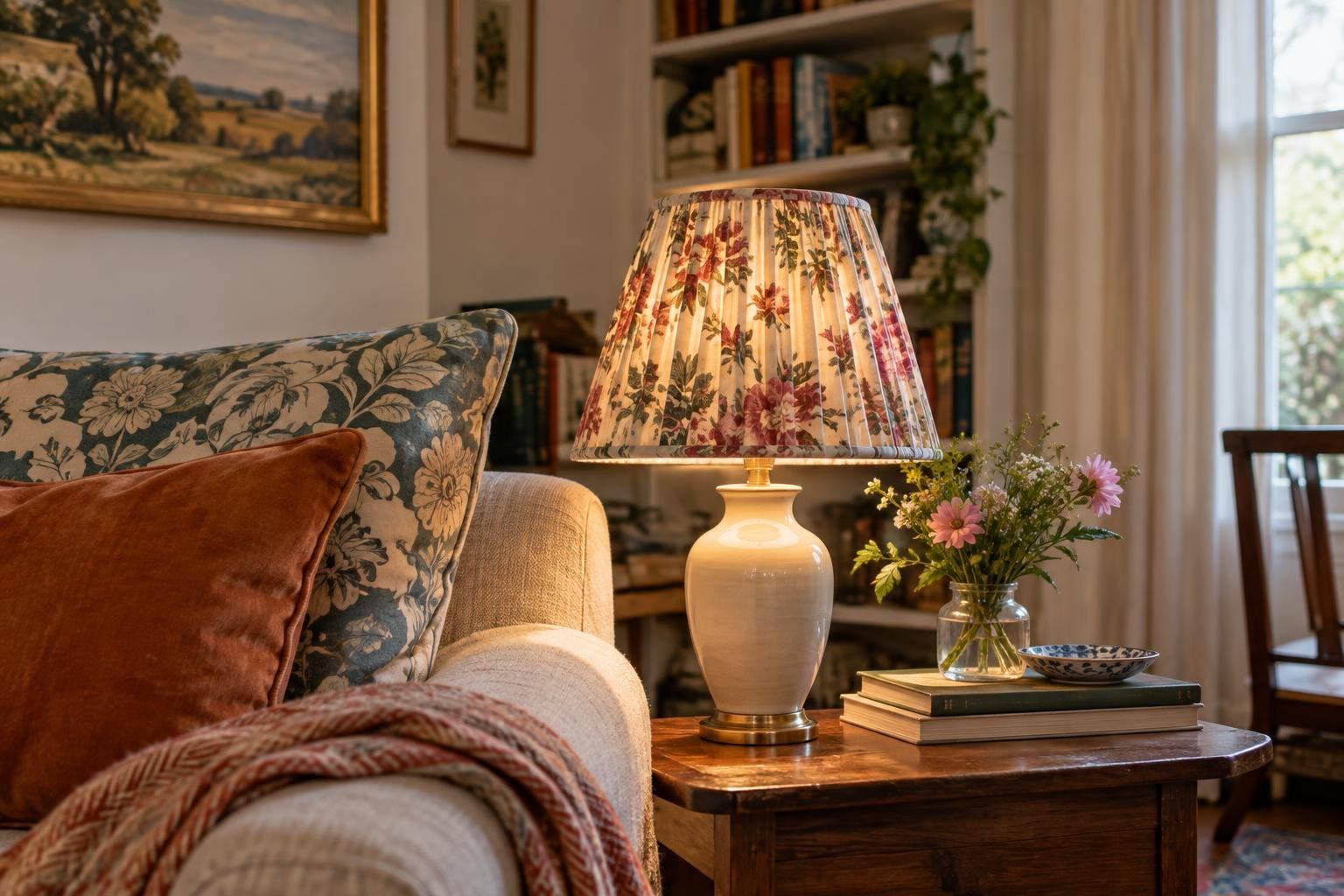
A room can have lovely furniture and still feel a little like a showroom. One small antidote is a lampshade with flowers on it: pleated, gathered or printed in a pattern that looks as if it has a story. Once easily dismissed as old-fashioned, the floral shade is finding a place in interiors that mix antiques, contemporary pieces and the everyday signs of a home in use.
Think of the welcoming rooms associated with Nancy Meyers films—not as a decorating recipe, but as shorthand for layered spaces, well-loved objects and lamplight after dark. The charm is in the mix, not in making everything match. A patterned shade offers a relatively easy way to add that sense of personality, whether it sits on a bedside table or a console in a small apartment.
A small detail with a bigger job
A lampshade is not simply a finishing touch. Fabric softens the view of a bulb, while the shade’s color, weight and lining affect how light comes through. Pleats and gathers add texture and can create subtle changes in shadow, giving a corner a different character from the more even light of an overhead fixture.
That makes a shade a useful decorating choice when a room feels stark at night. Rather than adding another cushion or blanket, you can change the quality of light in the places where you read, talk or unwind. It will not transform every room on its own, but it can make a modest pool of light feel more considered.
The renewed interest also reflects a broader appetite for rooms that feel collected rather than perfectly coordinated. Embroidery, gathering and block printing bring visible texture and the suggestion of handwork. Contemporary colors or an unexpected pairing can keep these traditional techniques from feeling like a period set.
How to make florals feel fresh
Contrast is the simplest way to give a decorative shade room to breathe. Try a small floral print against plain walls and clean-lined furniture, or set a delicate pattern beside a dark-painted wall or a simple ceramic lamp base. The difference between the shade’s prettiness and its surroundings is often what makes it feel current.
Scale matters, too. A tiny repeat can read almost like texture from across a room, making it a gentler choice when there is already a patterned rug or upholstery. A larger botanical design is more likely to become a focal point, so it may work best where the surrounding surfaces are comparatively quiet.
Mixing patterns is not off-limits. One bedroom scheme pairs a small red floral wall shade with botanical wallpaper, a blue patterned headboard and mustard accents. The useful lesson is not to copy the colors, but to notice how different print scales and complementary hues can help a layered room feel intentional without making every element identical.
Choose the corner—and the shade—with care
A living-room lamp beside a sofa can soften a space dominated by solid upholstery. In a study, a floral shade can provide a lighter counterpoint to dark colors and substantial furniture; at a bedside, it adds pattern at close range. Even a small lamp on a dining-room sideboard can make an evening setting feel more intimate.
Before buying, consider the lamp base, the room’s existing patterns and how much visual attention you want the shade to claim. A compact print is a quieter addition; a bold design will announce itself. Check that the shade fits the lamp and that the bulb and shade are suitable for one another, following the lamp maker’s guidance. That practical detail matters as much as the print when the light will be used regularly.
You do not need a complete room scheme—or a large budget—to try the look. Replacing a shade on a lamp you already own can be enough; a secondhand find may offer character, provided it is in sound condition and fits safely. And if florals are not your taste, the larger idea still holds: a shade can introduce color, texture or a little history without committing you to wallpaper or new furniture.
That may be the real appeal of the “fussy” lampshade. It brings decoration back to a corner that often gets treated as purely functional, and asks a room to be more than coordinated. A little pool of patterned light can make a home feel less staged—and more like somewhere life is actually unfolding.