
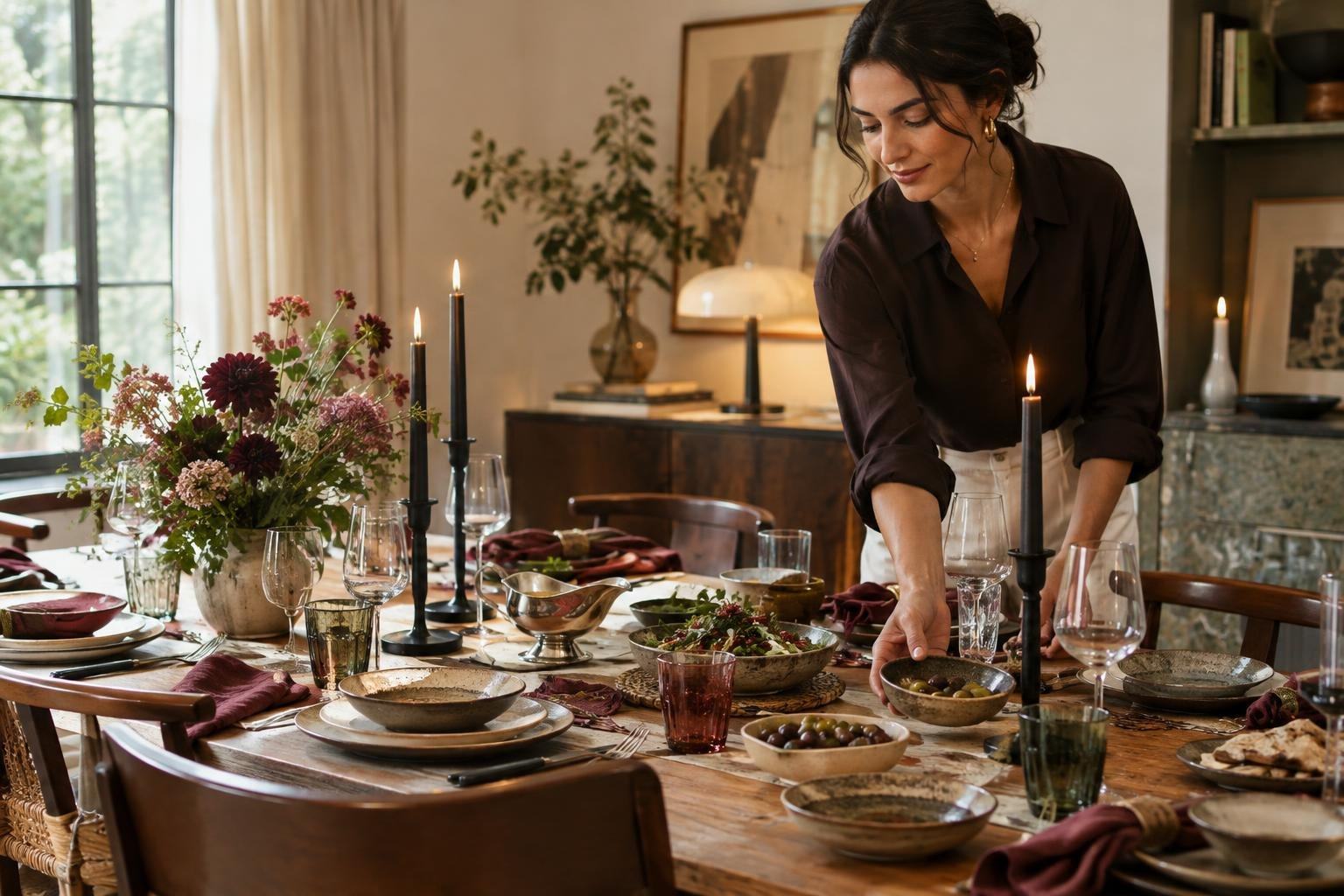
There is a particular pressure to make a dinner-party table look as though it came as a set: identical plates, matching glasses, candles in pairs. But a table can feel more welcoming when its pieces have different stories. The trick is not to collect more things. It is to make the contrasts look deliberate.
Interior designer Natalie Jahangiry takes that approach to hosting. Family meals, shaped by her partly Middle Eastern heritage, were a place to eat, catch up and talk; she sees the table as part of the welcome, not merely a surface for serving food. Her collection of tableware reflects that spirit: personal, layered and a little less formal than a perfectly matched setting.
Give the mix a thread to follow
Mixing styles does not mean every object needs to compete for attention. A simple way to bring an eclectic table together is to choose one or two details that recur: a colour, a material, or a shape. That thread lets different pieces sit alongside one another without making the table feel like a jumble.
Jahangiry, for example, pairs cool stainless steel with ceramics in earthy tones and burgundy, then introduces black candlesticks for contrast. The pieces do not match, but their varied finishes make the differences feel intentional. At home, the recurring note could be as modest as a warm colour picked up in napkins, a serving bowl and a candle.
It also helps to balance smooth surfaces with texture. Metal can look crisp; ceramic brings a softer, more handmade quality. Glass catches light, while a cloth napkin or a woven placemat adds another tactile note. The aim is contrast with a point of connection, rather than a table where every item is trying to be the star.
Let old and new share the table
Some of the most characterful pieces are not bought as a set at all. Jahangiry describes using vintage stainless-steel olive coupes and bringing family pieces, such as an old gravy boat, into the mix. A passed-down dish can carry a memory; a newer, simpler piece can give it room to stand out.
That approach also makes room for different budgets. A table does not need a designer collection to feel distinctive: use what you already own, then add selectively. One second-hand find, a handmade cup or an inexpensive accent can do more for the mood than replacing an entire cupboard. The useful question is not whether everything matches, but whether each piece earns its place.
Jahangiry’s response to Victoria Beckham’s homeware collection, created with Westwing, captures the distinction. She appreciates its refined monochrome and steel aesthetic, but questions the idea that it reinvents table-setting, noting that a £60 butter dish is a considered purchase. Her own preference leans towards a more mixed, personal look. It is a reminder that polished minimalism and collected eclecticism are both choices, not rules.
Use light and height to change the mood
Candles are not just another decorative object: their placement can help give a table a sense of depth. Jahangiry combines candlesticks at different heights, including black pieces that add drama. If you are borrowing the idea, vary the height without blocking sightlines across the table; the point is atmosphere, not an obstacle course between guests.
Glassware can play a similar role. Jahangiry likes elegant, fine-stemmed wine glasses alongside more colourful water glasses, rather than insisting that every glass belongs to the same set. It is a practical way to introduce colour while keeping a special glass for one drink and a sturdier, everyday favourite for another. There is no need to share her enthusiasm for a delicate stem—or to own a cupboard full of glasses—to make the idea work.
Before guests arrive, take a moment to look at the table as a whole. If one area feels too busy, remove a piece; if everything looks flat, try adding texture or a small difference in height. A welcoming table is not a test of taste or a shopping checklist. It is a collection of choices that gives people somewhere comfortable to linger—and perhaps a reason to ask where that old gravy boat came from.