
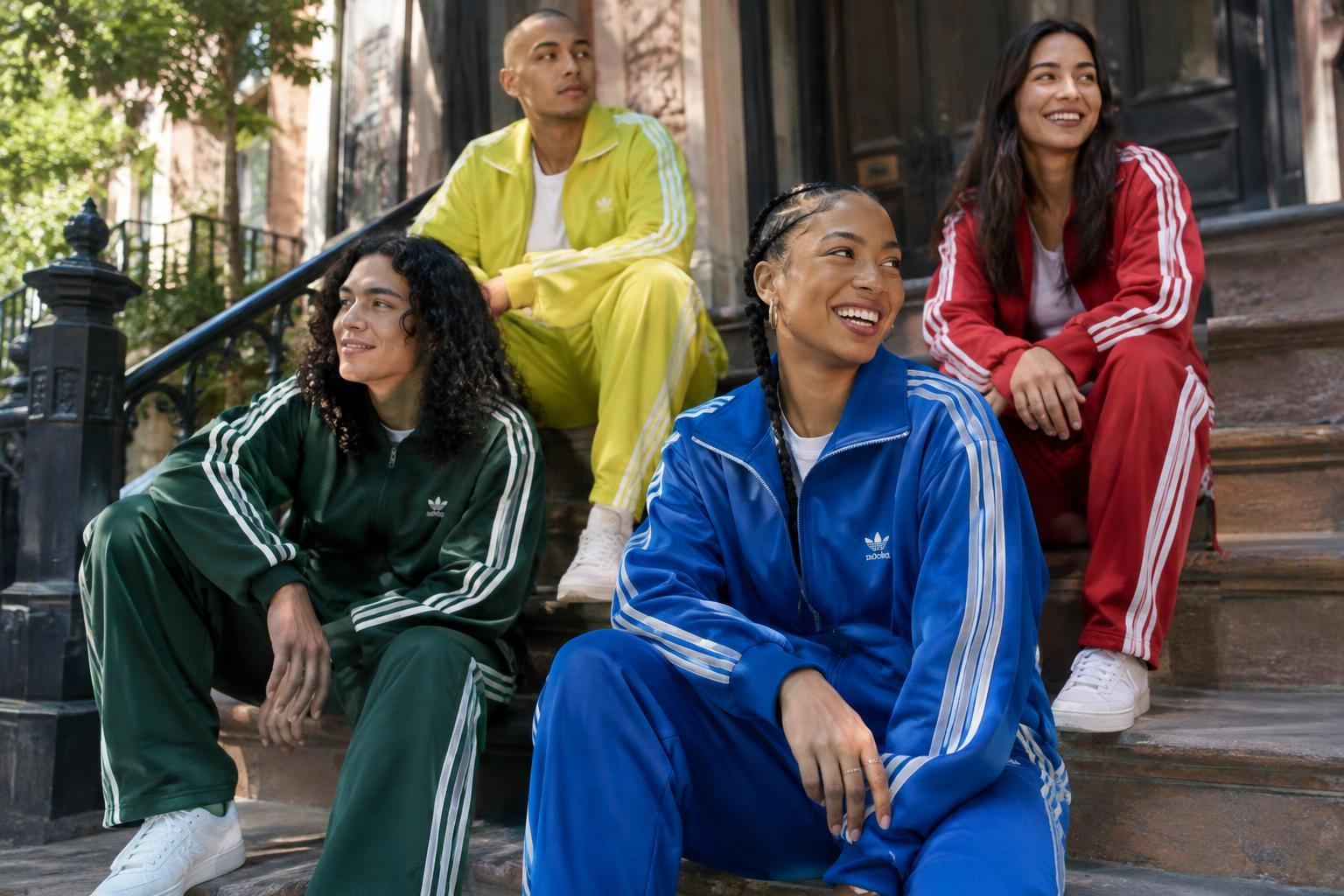
A tracksuit has an unusual talent: it can look like kit, a uniform or an outfit, depending on who is wearing it and how. Adidas’ versions have been part of youth culture since the mid-1960s, crossing scenes from hip-hop to grime. Now the brand is revisiting that shared wardrobe history with adiSignature, a new line shaped by American designer Willy Chavarria.
The first collection arrives on 23 October 2026, with more to come as part of an ongoing project. Chavarria, serving as creative adviser rather than presenting the range as a direct extension of his own label, describes adiSignature as a framework developed with Adidas. That distinction matters: the proposition is not simply a designer’s name stamped on familiar sportswear, but a longer conversation about how the brand’s established pieces might change.
Recognisable shapes, a different attitude
The collection reworks two 1980s Adidas staples, the Firebird and SST tracksuits. Their recognisable silhouettes provide a point of continuity, while relaxed tailoring invites layering and heavier fleece gives the clothes a more substantial feel. Two-sided zippers and retro logos add detail without making the basic idea difficult to read.
Colour is another way the line shifts the familiar. The palette ranges from fluorescent yellow to hunter green and true blue. Those choices can make a tracksuit feel less like an automatic matching set and more like a deliberate outfit: a bright jacket could carry a quieter base layer, while a strong colour worn head to toe leans into the tracksuit’s history as a statement of its own.
There is no single styling formula implied here. Someone who likes a cleaner look might break up the set with pieces already in their wardrobe; another wearer may prefer the full, relaxed silhouette. The useful idea is to treat proportions as a choice. A roomy top layered over a close-fitting tee, for instance, creates a different balance from wearing generous shapes throughout.
Streetwear as a shared language
Sportswear’s cultural reach helps explain why updating it is more than a matter of changing a hem or choosing a brighter shade. Adidas tracksuits have travelled beyond their original athletic associations, becoming part of many youth cultures. Chavarria’s earlier work with Adidas Originals also drew on his Chicano heritage alongside the brand’s signatures; adiSignature, by contrast, is described as a broader, continuing framework.
That breadth brings both opportunity and a question. A classic is recognisable because people have made it their own over time; a redesign can refresh that object, but it cannot manufacture the histories and associations that wearers bring to it. The strongest approach may be to leave enough of the original shape visible for people to recognise, while giving them fresh choices in colour, weight and how the pieces sit on the body.
The campaign, photographed by Brianna Capozzi and styled by Georgia Pendlebury, reinforces that emphasis on the wearer. It features a diverse cast and joyful, unscripted moments, rather than presenting the clothes as objects that need to be explained from a distance. The message is that the person wearing the pieces completes the picture—a welcome reminder that clothing gains meaning in use.
For shoppers, the practical question is not whether a tracksuit is having a moment, but whether its shape and feel suit the way they actually dress. A relaxed set can be worn together or split into separates, and a vivid colour may be the main event rather than an easy neutral. With adiSignature, the old uniform is the starting point, not the instruction: the most interesting styling decision still belongs to the person who puts it on.